Showing posts with label Inspiring Women Barbie. Show all posts

Friday, February 27, 2026

Black History Month and the Bessie Coleman Inspiring Women Doll

   I know you haven't heard from me for a while. I haven't had much to talk about, really. Winter has been a cold one. I don't know how it's been where you are, but here it got super cold, and we had a LOT of snow. Roads were closed and temperatures were in the single digits and below. I was very worried about Ken and his bad circulation from his diabetes. Last winter his feet got so cold that he developed and actual HOLE in one of his toes. So when it got so cold this year we escaped to Emma's house, where it isn't as cold as our big, old, uninsulated house. Fortunately we got there just before the big storm.

  We're back home now, since temperatures got back in double digits at night, waiting for the other storm to drop, as you might say. I think it's ended without coming this way. 

  We still have some problems though. When we left for Emma's our car had been running, but, even though we just had our water pump replaced AGAIN, it had started  smoking when I came home from the grocery store one night. While we were gone to Emma's Fuzz had to get something out of the car for me, and the battery was dead. We didn't have to go anywhere for a while when we got back, and I wasn't looking forward to walking the little over a mile from the garage back home, or sitting around the garage all day, so I had been putting off jumping the car and taking it in. I finally got our other  rechargeable battery jump starter back from Emma and we tried it. The car wouldn't start. We tried twice. I called AAA to jump the car. Actually, I couldn't call them. There's no number. I had to fill out something on line. I was assured, (in print) that they were on the way to jump the car. I went out and sat in the car so I would be ready. I waited half an hour, and then I got a call. The AAA guy told me he was at least an hour and a half away. I looked at the time and realized that by the time he got here and jumped the car the garage would be about to close for the day. So I waited until the next day. We dug out another battery jumper, and tried it, The car still wouldn't start. I felt awful the next day, and did a lot of sleeping. So the next day I called AAA again, and the guy came out in minutes that time. But of course, things weren't as simple as jumping the car. When he tried, the alternator smoked. That was apparently an indication that we need a new alternator. So he couldn't jump the car. He ended up towing it to the garage. They said they didn't need me, so I stayed home. They said they couldn't get to it that day. They said they could look at it the next day maybe, (Friday), but maybe not until Monday. Well, Monday rolled around and they called me. The car needs an alternator, but worse than that, there's a crack in the engine block. So it really isn't worth putting in a new alternator. We are now officially car-less. We might have a car in a week or two, but it's going to be something cheap, and when I say cheap I mean CHEAP. So it will have a lot of miles on it, so who knows how long it will last. And this car trouble means I missed the first doll show of the year, so sorry, no post on that.   

  In the meantime, I haven't done a Black History post yet this year. I was trying to think of a doll to do, and considered the first Black Barbie. I don't have one though, at least I might not, not for sure, and wouldn't know where she is if I do, so that would have been a complication.(Although I did once do a post on the second Black Ken doll. You can see that HERE.) Then the other day I was looking for something in the pictures in my phone, and I came across this doll


  She's Bessie Coleman, obviously. We'll check out the doll in a minute, but first, who was Bessie Coleman? 


  Elizabeth 'Bessie' Coleman was born in 1892, in Atlanta Texas, moving to Waxahachie at age 2. Her father, an African American  sharecropper, may have had Native American grandparents. (We'll get back to that in a minute.) Bessie was the 10th of 13 children, nine of whom survived to adulthood. When Bessie was six she started school, walking four miles to attend a segregated school. She excelled at Math, but had to leave school every harvest season to help bring in the cotton. 

  Her father moved to Oklahoma to look for work, leaving his family behind. At 12 Bessie went to school on a scholarship. At 18 she used her own savings to enroll in Oklahoma Colored Agricultural and Normal University, now known as Langston University. After only one year she ran out of money and had to leave school.

  Bessie's brothers moved to Chicago, and in 1915 she joined them there, attending beauty school, and getting work as a manicurist at a barber shop. She later took on a second job as manager of a chili parlour. Bessie loved listening to the stories of pilots who had recently returned from World War I, and thus began her interest in flying. She married Claude Glenn, a friend of her brother, in 1917. They soon separated. Supposedly they never lived together, and she never used his name. She rarely spoke of him.  

  Bessie saved her money, hoping to go to flight school. But in the U,S. African Americans and Native Americans were not accepted at flight schools. After taking a course in French, and with the help of Chicago Weekly Defender editor Robert S. Abbott, who helped Bessie contact schools overseas, Bessie went to France.in 1920 to study flight. Ten months later she was issued a pilot's license from the Federation Aeronautique, on June 15th, 1921, making her the first Black person in the world to become a licensed pilot. Bessie became the first Black woman, and the first Native American, ( I told you that would come in somewhere.), to be given an aviation pilot's license, and the first Black person and the first self-identified Native American to earn an international aviation license. She is also the first American of any race or gender to be given the license directly from the FAI, instead of applying to the National Aeronautic Association. 

Later that year she returned to the United States with the intention of opening a school for pilots. Commercial airlines were years in the future, so to earn a living Bessie realized she would have to become a stunt flier. But, for that, she would need more lessons, and she would have to develop her own programme of stunts and tricks. With nowhere in the U.S. to teach her such things, in 1922 she left again for Europe. After two months of advanced courses in France, Bessie traveled to Germany and studied under the chief pilot for the Fokker Aircraft Company.

  In September, 1922 Bessie made her first appearance in an American air show. The show was to honour the veterans of the 369th Infantry Regiment, an all Black regiment from World War I, which had ended just four years previous. The show billed Bessie as 'the world's greatest woman flier'. Bessie was sponsored by the Chicago Defender newspaper and Robert Abbott. 


  Bessie became a fixture at airshows and performed exhibition flights all over the United States. She earned the nicknames Brave Bessie and Queen Bess, for her impressive stunt flying. She was known for doing anything to complete a stunt. She still didn't own her own plane though, and at one point she opened a beauty parlour in Orlando Florida to try to earn money to buy her own plane.

  In her travels she often gave talks at churches and schools to encourage young Black men and women's interest in aviation. Bessie's two passions were promoting aviation, and fighting racism. At one stop Bessie reused to give her talk unless Black and White students were permitted to use the same entrance. Unfortunately they were still segregated inside. She also refused to perform at events where African Americans were not allowed to attend.

  In 1922 Bessie was signed to appear in a move called "Shadow and Sunshine", with the idea of making money to open her own flight school for African Americans. The movie was produced by the African American production company Seminole Film Producing Company, based in New York City. The studio was run by Peter P. Jones, an African American photographer and film producer, with the intention of creating high quality independent Black films. (There is a 1916 movie called "Shadows and Sunshine", and a later movie with a similar name. Neither have anything to do with the 1922 movie.), "Shadow and Sunshine" was to feature over 100 African American actors, and other African American aviators, including Edson O. McVey. (I can't find anything on Edson O. McVey. He appears to be lost in time, because you can usually find ANYTHING on the internet, and there is nothing on him. There is a current actor named Edison McVey. Not him.) The popular story goes that Bessie refused to appear, after learning that her first scene would show her in ragged clothes, with a walking stick and a pack on her back. She saw this as promoting the African American stereotypes she was fighting against. Other sources only say that Bessie went to New York for the filming, but failed to show up for, not only the filming of "Shadow and Sunshine", but other projects she had agreed to appear in for the company. Bessie's departure, and the company's business struggles meant the film was never completed, and the company eventually ceased operations. (Peter P. Jones is a fascinating guy, a pioneer in early colour film processes, and the first African American to lead a department of any major White studio, when he was appointed head of the photo department for Lewis J. Selznick's Selznick Pictures. (Lewis Selznick was the father of David O. Selznick, the producer of "Gone With the Wind", and Myron Selznick, producer and talent agent, who brought his client Vivian Leigh to the set of "Gone With the Wind" during the filming of the burning of Atlanta sequence, and introduced her to his brother, thus ending the famous and highly publicized attempt to find an actress to play Scarlett.) He also mysteriously disappears from History after  1950. His life would make a great movie. You can read about him HERE.)


  In February of 1923, during a flight from Santa Monica, Bessie's engine stalled, and her plane crashed. She suffered a broken leg and fractured ribs. Bessie asked the doctor to 'patch her up' so that she could perform at an airshow she had scheduled. They refused, and Bessie was grounded. She spent months in a hospital, where she planned her flying school while recovering. Bessie didn't return to flying until 1925.

  Bessie bought a Curtiss JN-4 "Jenny" airplane, a 2 seater open cockpit plane developed for use in World War I, in Dallas, Texas. In April of 1926 her mechanic, William D. Wills, who was also her publicity man, flew the plane from Dallas to Florida, where Bessie was to appear at an air show. On the way  Wills had to make three 'forced landings', which are described by Wikipedia thus:

 "The aircraft is forced to make a landing due to technical problems. Landing as soon as possible is a priority, no matter where, since a major system failure has occurred or is imminent. It is caused by the failure of or damage to vital systems such as engines, hydraulics, or landing gear, and so a landing must be attempted where a runway is needed but none is available. The pilot is essentially trying to get the aircraft on the ground in a way which minimizes the possibility of injury or death to the people aboard. This means that the forced landing may even occur when the aircraft is still flyable, in order to prevent a crash or ditching situation."

The plane was not in the best condition, and Bessie's loved ones begged her not to fly it. Bessie ignored the possible danger, and went up with Wills to check out the terrain for a parachute jump planned for the following day. She wasn't wearing her seat belt, as she needed to look over the side of the plane to see the ground. Shortly after takeoff, at an altitude of 3000 feet, the plane suddenly went into a dive, and a spin. At 2000 feet Bessie fell from the plane and died upon impact. The plane crashed, killing Wills instantly. Although the plane exploded and burned it was determined that a wrench had been left in the plane during repairs, and had jammed the controls.

  Funeral services were held in Florida and Chicago, where they were led by newspaper owner and activist Ida B. Wells, herself the subject of a doll in this same series. You can see my post on that doll, and read about Ida HERE.  I'd still love to get the Ida doll. I did eventually get the Madame C.J. Walker doll, (You can see that post HERE. ), but I'd rather have Ida. 

  You can learn more about Bessie, see some photos of her, and read some of her actual quotes HERE.

  As for the doll, Bessie is part of the Inspiring Women series by Mattel. She's all kitted out in her flying togs, including  a green jacket and jodhpurs, white scarf, belt, boots, and flight cap.


  The Mattel site describes the doll this way: 

The Barbie® Inspiring Women™ series pays tribute to incredible heroines of their time; courageous women who took risks, changed rules and paved the way for generations of girls to dream bigger than ever before. Despite facing racial and gender discrimination, Bessie Coleman became the first Black and Native American female aviator and the first Black person to earn an international pilot’s license. Sculpted to her likeness and wearing a traditional olive-green aviator suit, including a “BC”-initialed cap, this collectible Barbie® doll honors a high-flying icon. Includes doll stand and Certificate of Authenticity. Barbie® doll cannot stand alone. Colors and decorations may vary.

  • This Barbie® Inspiring Women™ doll honors Bessie Coleman. She was the first Black and Native American female pilot, and the first Black person to earn an international pilot’s license.
  • Bessie Coleman Barbie® doll wears a traditional olive-green aviator suit, tall lace-up boots and a cap emblazoned with her initials: “BC”.
  • As someone who loved flying through the sky and performing aerial tricks, she naturally comes with a helmet and goggle accessories!
  • May this aviatrix’s trailblazing achievements and remarkable courage inspire people everywhere to soar to greater heights.
  • The Bessie Coleman Barbie® Inspiring Women™ doll comes in displayable packaging, making her a wonderful gift for collectors and children ages 6 years old and up.

   Let's start with the likeness. She's pretty, but doesn't look anything like Bessie Coleman, and this face seems to be the same one used on other dolls.

    Her hair is cute, but I've seen pictures of her with her hat off, and it looks a little goofy without the hat.


Her outfit is really nice. 


  I like that they made an all new boot mold for her, and didn't try to just get by with any old boots.


But I don't see the helmet and goggles she's supposed to come with. Does anybody have this doll? Are they in the bottom corner of the box, behind the pictures?    

  She also comes with a stand, and a certificate of authenticity. 

  She has the regular articulation of neck, shoulders, and hips, plus jointed elbows and wrists. For some reason the Mattel site doesn't even bother to tell you that.

  So that's the Black History Month doll for this year. I wondered if I was going to make it in time! I'm coming in just under the wire. I have been having some eye problems, and I desperately need new glasses. So I have a terrible sick headache and I'm ready to finish this post! I'll hopefully see you soon, and more clearly! The next time you see me I will most probably be an old lady of 64, as my birthday is less than two weeks away.

Saturday, February 18, 2023

Doll-A-Day 2023 #43: Inspiring Women Madame C.J. Walker

   Today we're celebrating Black History Month with this lady. She's Madame C.J. Walker.

The 'C.J.' is from her third husband, Charles Joseph Walker. As is still often the case, women were called 'Mrs. Whatever-their-husband's-name-was'. I had a friend who always addressed her mail as 'Mrs. Her-Husband'. When I get mail as 'Mrs. Ken...' it really rubs me the wrong way. I have my own name, and it's not 'Ken'.The 'Madame' is after the popular French beauty products makers of the day.
   

  I hadn't actually heard of her, until I saw this doll in a store the other night. I have done some reading since then. She was quite a lady.

The doll doesn't look anything like her.


  From an article by Madame Walker's great great granddaughter, A'Lelia Bundles, I learned that not only was Madame Walker born to former slaves, but she was born, (in 1867), on the same plantation in Louisiana where her parents and older siblings had previously been slaves, but were then sharecroppers. 

  Born Sarah Breedlove, her parents died when she was 7 years old. She married at 14, and at 18 gave birth to a daughter. Her first husband died when she was 20 years old, and with a two year old to care for, she worked as a washer woman to earn a living. At the age of 38, she developed her first hair care products, stemming from the public's need to regrow hair and kill bacteria caused by not being able to wash their hair regularly because indoor plumbing was still undeveloped. Madame Walker formulated a shampoo and a medicinal ointment for scalp infections. Initially she sold her products door to door, and through mail order, before opening a beauty parlour and school to teach what Madame Walker called 'hair culturists'.

  At one point Madame Walker was accused by a previous employer, Ann Malone, owner of the Poro Company, of stealing her formula for a hair care product made of sulfur and petroleum jelly. But the product had been used for a century, so Malone didn't have a leg to stand on. Malone was Madame Walker's biggest competition in later years.  

  Madame Walker has been a source of controversy over the years. Many lumped her together with those wanting to straighten natural hair in an effort to meet standards of Caucasian or European beauty.  Her great great granddaughter wants people to know that Madame Walker did not want to straighten hair, but grow hair, and keep it healthy. Madame Walker stated that she 'deplored' the impression that she wanted to straighten hair, claiming that she was 'a hair culturist. I grow hair.'

Madame Walker's 'Beauty Culture School'.

  Madame Walker is the first documented female self made millionaire, according to the Guinness Book of World Records. There may have been others before her, but she is better documented. She was also a patron of the arts, and a philanthropist, contributing to many YMCA and YWCAs, the Tuskegee Institute and other schools. Madame Walker was involved in many projects aimed at teaching African Americans, especially women, to start their own businesses. She was on the executive committee of the New York NAACP. She was a busy woman, and my shoulder is bothering me today and typing hurts, so if you want to know more about her life, and her involvement in philanthropy and politics, you can go to her Wikipedia page HERE, and an article about her by her great great granddaughter, A'Lelia Bundle, HERE.

  And now let's look at that doll a bit more.

  This doll is part of the 'Inspiring Women' series. 

Her dress has a really nice texture.

  The series has previously featured Ida B. Wells, (You can see my post on her HERE.), Katherine Johnson, Rosa Parks, (You can see my post on those dolls HERE.), Susan B. Anthony, Helen Keller, Jane Goodall, (I want that doll!), Frida Kahlo, Amelia Earhart, Bindi Irwin, Ibtihaj Muhammed, Sally Ride, Billie Jean King, Florence Nightingale, and Ella Fitzgerald, among many others. There are so many of those I'd love to have! 

  It seems like special sculpts that actually look like the real person are made for only some of the Inspiring Women dolls. Some have to ride along on the sculpts Mattel already has in use. I wish they would make special sculpts for all the dolls. This one doesn't look like it's subject at all, as far as I can tell. There aren't many pictures of Madame Walker online though. Maybe she looked and wore her hair like this at some point in her life.


  The ruffle on her blouse has unfinished edges. The white edges also make me thing that the colour and design is only printed on the front, and the back of the fabric is plain white.

Pretty blouse though.

Her skirt in nice. I like the textured fabric.


 As you can see from the pictures above, she has jointed wrists, and probably elbows too. She's holding a tiny reproduction of a Madame Walker hair care product.


  I would have loved to have bought this doll for the post when I saw her at the store, but she was $50. Add to that the fact that I am trying to cram too much into Emma's house right now anyway.  

That's the doll for today. Tomorrow we'll see another doll.

Friday, February 25, 2022

Black History Month and the Ida B. Wells Inspiring Women Doll

   This is Black History Month. I am late in getting a post up, but this year it seems more important than ever to focus on and celebrate the accomplishments and contributions of African Americans. I try to keep the blog my 'happy place', but the world has gone crazy, and it scares me.

    I was really wanting to post about the Ida B. Wells doll from the Inspiring Women series. 


I haven't been able to find her in a store though, and the cheapest I could find the doll online was going to end up being over $30, and closer to $40 with the postage, and I wasn't wanting to spend that right now. I have a birthday coming up very soon, and I don't know what Ken may have already bought. Not that he should buy me anything, because I totally failed his birthday. I had several things in mind for him, which I could either not find, or didn't work out for various reasons. I did bake him his favourite birthday cake, (The same kind I showed you that I baked for Lori's birthday. You can see what it looks like HERE.)

  Anyway, I have decided to instead resort to using stock Mattel pictures and telling you a bit about Ida B. Wells. First, the real Ida B. Wells.


  To start with, Ida B. Wells was born in Holly Springs, Mississippi, in 1862. Her parents were slaves, although her father was born to a White man and a slave woman. Ida's mother had been sold away from her parents and siblings, and after the Civil war she tried, unsuccessfully, to find her family. Ida was born in the house where her parents lived as slaves. In those days it was called the Boling-Gatewood House. Now it is called the Ida B. Wells-Barnett Museum. (Go Ida! My sister was just today talking about Ronald McNair, who, at the age of nine, was denied the right to check a book out of a library because he was an African American. He sat on the counter in protest, and the librarian called the police and his parents. The police made her give him his books. He went on to earn a PhD. and become an astronaut. (He unfortunately died in the Challenger explosion in 1986.)The library is now named after him. My sister said if she were him, she wouldn't have allowed them to name the library after him. I said I thought it was the ultimate revenge.) When the Civil War ended Ida's father, who had been taken at 18 by his father to Holly Springs to become a carpenter's apprentice, ran a successful carpentry business. Her parents also became politically active in The Reconstruction. Ida attended Shaw, (now Rust), college, where her father was a trustee, until she was expelled for a dispute with the president of the university.  Already Ida was voicing her opinion, no matter the cost.

  Sadly, Ida's parents and baby brother died in a Yellow Fever epidemic when she was 16. To avoid her remaining five siblings being separated and sent to foster homes, she took a teaching job to provide for them. Ida eventually moved her family to Memphis, Tennessee.

   In 1884, after buying a ticket for the First Class ladies car on a train, Ida was told by a conductor to move to the already overcrowded smoking car. Ida refused and was thrown off the train. She hired an African American lawyer, who was paid off by the railroad. She then hired a White lawyer and sued the railroad. She won the case in the local circuit court, and was awarded $500, but lost when the case was appealed and went to the Tennessee Supreme Court.

  Ida was a co-owner of  the newspaper The Memphis Free Speech and Headlight. After a friend was lynched in 1892, Ida became one of the first people to investigate the lynching of African Americans. She published a pamphlet, "Southern Horrors: Lynch Law in all It's Phases", and published articles on the subject. Her articles were carried, across the country, in newspapers owned by African Americans. From her investigations of lynching, Ida became aware of the case of an African American man who was lynched because he was having  relationship with a White woman. She found there were many cases of  African American men and White women in relationships, where the man was lynched as a rapist, to 'save the reputation' of the women. She published an editorial in May of 1892,part of which read, "that old threadbare lie that Negro men rape White women. If Southern men are not careful, a conclusion might be reached which will be very damaging to the moral reputation of their women." Four day later, Ida, who was in Manhattan at the time, was threatened by the newspapers The Daily Commercial and The Scimitar, The offices of  Free Speech were trashed and the printing press burned. Ida's co owner, James L. Fleming, fled Memphis, and Ida herself never returned. At the time, the trains were being watched for her.

  In 1895 Ida married African American lawyer Ferdinand Barnett. They had four children. Ida remained an activist, and travelled abroad to lecture, to spread the word about lynching. She criticized women's Suffrage activists for ignoring lynching, and in turn was ridiculed by Suffrage groups. In spite of that, Ida supported women's rights and was one of the founders of the National Association of Colored Women's Club, which worked to support women's suffrage and civil rights. Although often  mentioned as one of the founders of the NAACP, her role is sometimes disputed. 

    Ida B. Wells-Barnett passed away in March of 1931. In 2020 she received a posthumous Pulitzer Prize citation for "outstanding and courageous reporting on the horrific and vicious violence against African Americans during the era of lynching".

  There's a great page to read about Ida B. Wells HERE. Of course, there's also the Wikipedia page HERE.

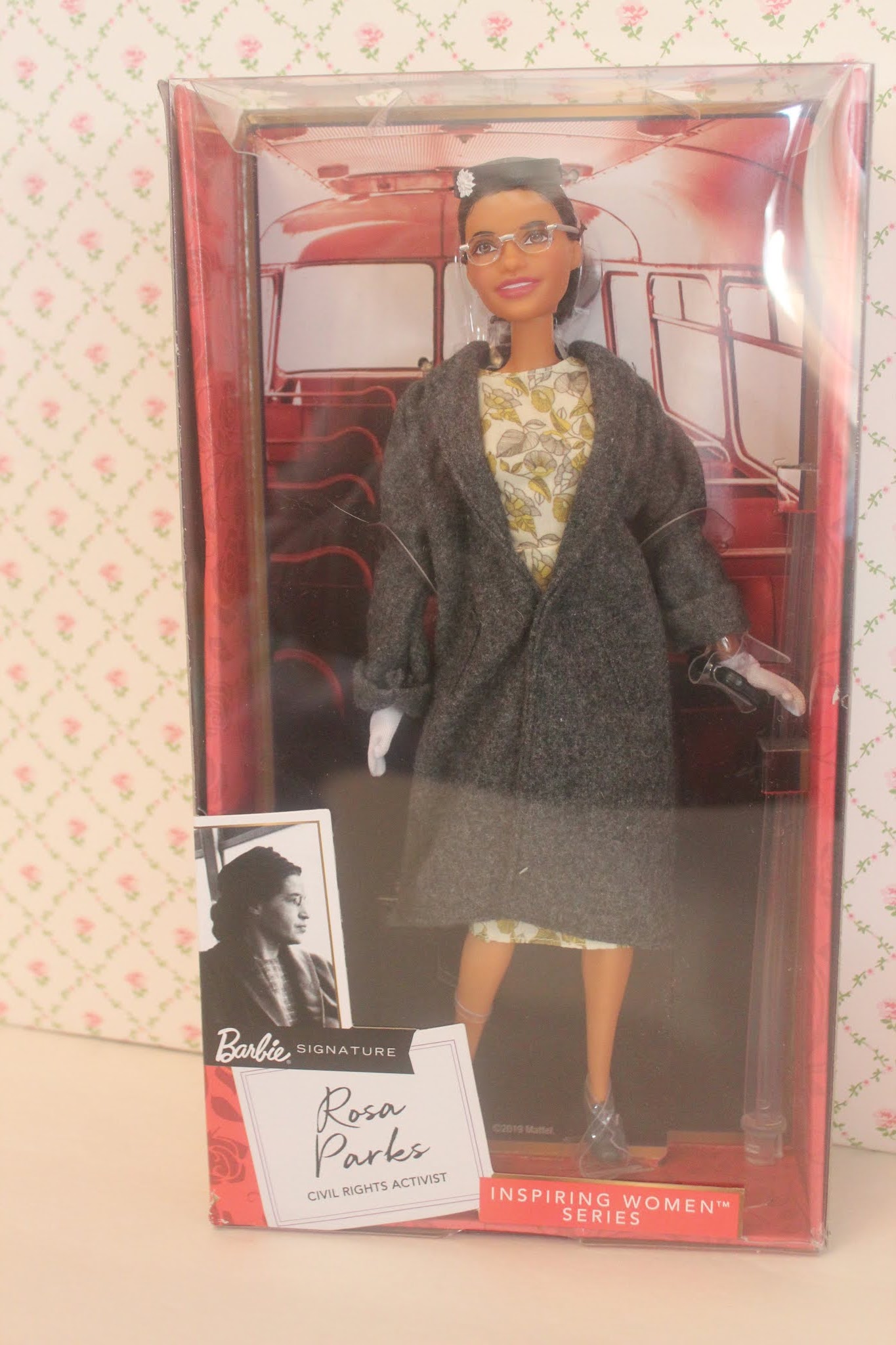
  Now, on to the doll. The Ida B. Wells doll is one of the most recent in the Barbie Signature Inspiring Women series by Mattel, having been released in January. Previous dolls in the series have included Billie Jean King, Helen Keller, Maya Angelou, Florence Nightingale, Eleanor Roosevelt, Susan B. Anthony, Sally Ride, Ella Fitzgerald, Rosa Parks, and Katherine Johnson. You can read about those last two, and see the dolls, in my post HERE. (And for those of you who thought I should have just kept Rosa Parks too, even though she was received when Walmart's website switched Ken's order from Katherine Johnson to Rosa Parks without him noticing, and I promised to return her...well, Ken never returned her, and gave her to me for this birthday. He thought I could do a post on her, but I already did that when she was still in her box. Maybe I will do a post showing Rosa free from her box.) 

  The doll uses the Curvy Made to Move body, according to the Mattel website.


  I don't know about her having jointed knees and ankles, but she certainly has jointed elbows and wrists, as we can see from the stock Mattel photos.


  According to Mattel the doll has been 'sculpted in her likeness'.


I don't think she looks much like the real Ida, and looks very like other dolls in the Barbie line.  What do you think? I do think they did a pretty good job of copying the hairstyle.

Compare this to the picture of the real Ida B. Wells above.


  Her dress is wonderful.


The fabric looks to be a really nice quality, and the trims are fairly in scale.  

  And those boots!

These boots are awesome!

Mattel finally did it! These are the boots they should have put on their May Poppins doll, (in a different colour, of course),instead of regular high heels with spats over them.

  She even comes with a tiny copy of her newspaper.


  I really like this doll, even if I didn't know anything about the real lady. I think she's one of my favourites in the series. I think I'd like to have this doll, Susan B. Anthony, Ella Fitzgerald, and Helen Keller.

  I'll be back very soon, because the Doll Book of the Month Club is coming up, plus I have another couple of posts planned, and there's a doll show in two days! Whew! So I'll see you soon.

Thursday, February 25, 2021

Celebrating Black History Month with 'Katherine Johnson' and 'Rosa Parks'.

   I haven't posted much, so I bet you were all thinking I was going to miss Black History Month this year, weren't you? Well, it's coming down to the end of the month, but here I am! 

  I have had my eye on the Katherine Johnson doll for a while now. She was actually released in 2018. I have often said that I collect on a budget. The $30 price suggested I wait for Katherine to show up on clearance or a yard sale somewhere. Then, of course, she disappeared, as the new dolls in the 'Inspiring Women' series were released. But recently I spotted Katherine in a Black History Month display at Target. I was reminded how much I liked her, (and her glasses!), and I said to Ken how I have a birthday coming up, and if I got her before my birthday, she would make a great doll to post for Black History Month. He pretended to be ignoring me. Fortunately though, he had ordered her for me.

  I was surprised when Ken said he had bought her from Walmart.com. After we had spotted Katherine at a very out of our way Target that we only went to because Ivy needed something from Target and we had gone somewhere very out of the way to get something Ken wanted, I looked up where I might get her online, I saw that she was sold out on Walmart.com. I figured it was because she was a more than two year old doll, and Mattel had moved on to new dolls in the series. So I was surprised Ken got her, but still not expecting that when I opened the box, it wasn't a Katherine Johnson doll, but a Rosa Parks one!

  Ken swore he ordered the right doll. He got on Walmart.com, to see what happened. There was nothing saying what he had actually ordered. So he tried to order a Katherine Johnson doll, and found that it automatically changed the order to a Rosa Parks doll! It must have shown him Katherine, and changed it to Rosa, another doll in the 'Inspiring Women' series, without Ken noticing. So beware if you order from Walmart.com.

  I had to go to a Target, (Not all of them seem to have Katherine Johnson, but fortunately the closest one did.), and buy a Katherine Johnson doll. Rosa will have to go back, because two $30 dolls in one go is too much to spend. But since she's here now, I thought we'd have a look at her too.


 Born in 1913, Rosa Parks, as most people know, became a civil rights icon, when, in 1955, she refused to give up her seat on an Alabama bus to a White woman. Rosa was employed as a seamstress at a department store at the time,  and was fired for her act of 'civil disobedience'. Her arrest led to the boycotting of Montgomery Alabama buses by African Americans for over a year. Rosa Parks became the face of the segregation movement in Alabama, not, according to Wikipedia, because she was the first to refuse to give up her seat to a White person, but because the local NAACP thought Rosa would be a good candidate to win her court case. 


  Rosa, who had served as secretary of the Montgomery chapter of the NAACP from 1944 to 1957, continued to be active in the civil right movement, serve as secretary to U.S. Representative John Conyers, write her autobiography, be awarded the Congressional Gold Medal of Honor, the Presidential Medal of Freedom, the NAACO Spingarn Award, and was the first woman to lie in honour at the Capital Rotunda.

  Irony abounds. While secretary of the Montgomery NAACP, Rosa faced discrimination based on her sex. Her boss, local NAACP leader Edgar Nixon, was quoted as saying, "Women don't need to be nowhere but in the kitchen." While the segregating of the buses was ridiculous itself, there was the further unfairness of the fact that the seat Ms. Parks was asked to give up, and arrested for not doing so, was in the back of the bus, in the seats relegated to African Americans. (The White seats were full. This reminds me of the treatment of Native Americans. 'Hey, remember that land we gave you, which was actually yours in the first place because you were here first, and not ours to give you? Well we discovered oil on it, so we want it back.') 

  Rosa passed away in 2005.

  As for Rosa's doll, released in 2019, remember she has to stay in her box because she has to be returned.


Rosa is dressed in a floral and leaf print cotton dress...


... 'sensible shoes'...


... white gloves...


...and her famous 'wool' coat and pill box hat.


And don't forget her glasses.


Her glasses are sewn to her head.

In her hand is... a clutch purse? Yes. According to Mattel, that's what that is.


Her hair is pulled back, and there are painted on wisps of hair around her hairline.


   She also comes with a three part stand. The glasses and the coat, which are two things I usually love anyway, are my favourite accessories. Mattel describes this doll as having a 'posable torso w/articulated knees. I'm not sure if this is a new sculpt for this doll, or if it's just the way it's painted. Barb, do you know?

  Now for Katherine Johnson. Not to belittle Rosa Parks' contributions to the world, but have you ever read anything about Katherine Johnson? She's amazing! 


Born Creola Katherine Coleman, in West Virginia in 1918, Katherine showed incredible math skills as a child. Unfortunately, the county she lived in didn't offer public schooling to African Americans after grade eight. Katherine's family was forced to find schooling for their children in another town, and Katherine was enrolled in high school at Institute, West Virginia, at the age of ten. The family lived in Institute during the school year, returning home to White Sulfur Springs when school was not in session. Katherine graduated from high school at the age of fourteen. She then enrolled in West Virginia State University, where she took every math course available. New math courses were added just for her. In 1937, at age 18, Katherine graduated Summa Cum Laude, with degrees in mathematics and French. She accepted a teaching job, but left after two years to enroll in a graduate math program.

  After time off to raise her children and do her graduate studies at the West Virginia University, where she was one of the first three African Americans to be accepted, Katherine returned to work in mathematics. She accepted a job at the Langley Memorial Aeronautical Laboratory in 1953. She worked in a pool of women, reading data from the 'black boxes' from airplanes, and performing other mathematical jobs. When Katherine was borrowed by the all male flight research team, she so impressed them with her skills that they kept her on the team. For five years Katherine worked as an analyzing 'computer'. Eventually Katherine worked in the Guidance and Control Division. There was plenty of racial and sex discrimination, with Katherine and her fellow black female 'computers' being forced to use separate restrooms, working, and eating areas from the White workers. 

  In 1958 Nasa began to use non-human 'computers'. Katherine worked as an aerospace technologist from 1958 until she retired in 1986. When computers were used for the first time in space travel, to calculate John Glenn's orbit around the Earth, Glenn asked that Katherine verify the computer's numbers, and refused to fly until she had! In 1961 she calculated the trajectory of the first American manned flight in space, (Alan Shephard.) She plotted space navigation charts. She was even part of the team that navigated the trajectory for the flight that landed on the moon in 1969. She also helped get the crew of the failed Apollo 13 mission safely back to Earth with her back up procedures. That's one pretty awesome woman.

  Katherine later worked on the space shuttle and plans for a mission to Mars. Katherine passed away last year, at the age of 101.

  Here's the doll.


  Fresh out of the box, and free of her insert, she still had a plastic thing attached to her back like a wrong side out turtle shell. In fact, when I laid her on the couch she rolled over just like a turtle on it's back.

Her box insert is a picture of the Nasa control room.


She wears a pink cotton dress with a white collar and buttons on  the bodice...


...and a space ship on the collar...


...a black belt...


...black heels...


...a 'pearl' necklace and earrings...


...her Nasa I.D. badge...

It's on a silver string that ties in back.

...and her glasses!


I love these glasses! My mom wore glasses almost exactly like these.


 Her glasses have non-collapsible legs, and are all one piece. The only difference is that the frames are painted and the lenses aren't. They are sewn to her head.


  According to Mattel she has a Fashionista standard torso with articulated arms.


She's jointed at the neck, shoulders, elbows, wrists, and hips.


Her legs are the hard, non-bendable type. They can spread out from the hips though, for some poses with attitude.

Her face mold is described as the MOTM Nichelle sculpt.


She has one piece of hair pulled back and held with an elastic band.


I found when I saw the dolls at the store that there is a wide range of quality with the hair. It's one reason I don't regret having to go to the store and get a doll. Some have tight curls on the forehead. Some have a big loose wad of curls there. There were some dolls with loose chunks of hair in the back and at the sides. Some dolls only had a half curl at the edge of the forehead. Some had huge fluffy heads of hair. I saw the absolute perfect doll the first time I saw her in Target. This one is the second best, with a nice tight bunch of curls on her forehead.


  Maybe all those differences are because her head isn't caked solid with hair spray. A lot of dolls now days have hair that's rock hard with crap. I was glad to see,(or rather, feel.)  that her hair is just short of stiff. Of course,  I'm not good with hair, so this might not be the blessing I think it is! I recently found that my Made to Move doll's hair is disgustingly greasy feeling.

She comes with a certificate of authenticity.


She has a three piece stand.


  I really like this doll. Everything about her is great, with the exception of the cheap molded plastic necklace. I think since she's directed at adult collector's she should have had a bead necklace. It wouldn't have affected the price that much, would it?

  So there you have it. I'll see you soon. I confess to buying some stuff recently...