Showing posts with label children's books. Show all posts

Saturday, February 10, 2024

The Doll Book of the Month Club: The Bad Times of Irma Baumlein/Irma's Big Lie

   It's time I caught up a little bit here, and delivered last month's Doll Book of the Month Club entry. It's "The Bad Times of Irma Baumlein", also produced in a Scholastic version as "Irma's Big Lie". 


That's the version I have from when I was a kid. That's the version I read to my kids when they were little. For my refresh to my memory, since I was at Emma's, I used a second hand hardback copy I rescued from the books from the fire. Luckily it didn't suffer any damage, and is in really nice shape.

  Whichever title you want to use, I always liked this book. It's by Carol Ryrie Brink, who  I didn't even realize wrote the famous "Caddie Woodlawn", and another kid's book I read a couple of years ago, just because it looked like the kind of book I liked as a kid, "The Pink Motel". She published her first book in 1934. 'Irma' is one of the last books she wrote, published in 1972. 

The illustrations are by Trina Schart Hyman. Her work was used in a lot of kid's books when I was growing up, so her illustrations always give me a warm, familiar feeling. She illustrated about 150  children's books, and her art included black and white illustrations like the ones in 'Irma', as well as beautiful colour illustrations in editions of  "Snow White", "The Secret Garden", and  "A Christmas Carol".  

  "Irma's Big Lie" concerns a girl named Irma Baumlein. Irma has moved with her father, from her 'cozy' apartment in New York, to the huge Baumlein mansion in another town. 


Irma and her father, (Her mother is finishing painting a mural and is supposed to join them when she's finished.), now live with Irma's grouchy great uncle and deaf great aunt, as well as their two servants.


 Irma's father has come to help his uncle modernize the family department store, founded by Irma's grandfather. The Baumleins are big names in town, but Irma doesn't feel big. She feels lonely as the new kid in school, and in the big house, where her father doesn't have time to talk to her very much, as business and his uncle have been taking all his time.

  Irma makes a habit of trying to look disinterested. But one day, weeks after their move, one of the girls from school strikes up a conversation with Irma, and invites her to her house on the way home from school. She's  a very friendly girl, who explain she has a big family, with a baby, a dog, and a bunch of hamsters. After reeling off all that news she asks Irma, "What do you have?" She wasn't trying to brag, just explain her family. She very likely meant, did Irma have any siblings, or, a dog or cat. But Irma feels pressured to top her, and blurts out, "I have the biggest doll in the world.". Irma doesn't even like dolls, preferring chemistry sets. She has no idea why she said it, but she goes on with the pretense, explaining that the doll can wear her clothes, has hair the colour of ripe oranges, and eyes that are cerulean blue.

  After her lie, Irma feels terrible, and doesn't know why she said it. She wishes she could take it all back, but the lie spreads to all the kids at school. 


  Irma is asked to bring her doll for a fundraising exhibit at school. She can't let her class down, as the class who raises the most money wins a prize. Irma searches desperately for a doll that can pass for the biggest doll in the world. Her great aunt offers Irma her old doll, which is, she says, very large. Irma gets excited, but the dolls turns out to be old and somewhat big, but can no way pass for the biggest doll in the world, and definitely does not have hair the colour of ripe oranges or eyes that are cerulean blue. Irma takes her anyway, and bonds with her great aunt, who obviously loved her doll very much.

  Irma's father mentions that the new shipment of dolls is in at the store. Irma puts together all her money, including birthday money she's been saving, and would rather spend on a chemistry set, and goes off to her great uncle's store. Her search of the doll department is fruitless, but on her way out, Irma sees a mannequin that has been removed from the window, a mannequin the size of Irma, with hair the colour of ripe oranges and eyes that are cerulean blue...and she's standing right by the exit door. You can guess where this is going.

  Irma's experiences with the doll are funny and tense. Does she get it home undetected? Does she manage to get it to school undetected? What happens at the school exhibit? Does Irma's lie get exposed? I won't say. It's an enjoyable book though, with a satisfying, if unlikely ending.

  That's the book for January! I'll be back very soon with February's book, and maybe a doll or two.


Monday, October 31, 2022

The Doll Book of the Month Club: Cozy Classics, Les Miserables?

   Even though I'm away, the Book Club lingers on. This month's Doll Book of the Month isn't about dolls, but the illustrations are all doll. The book is from the Cozy Classics collection, published by Chronicle Books. It's a board book, and so you'd think it must be for very small kids, right? And what is this wonderful, cozy classic for tiny children? Why, Les Miserables, of course.


  Now, if there's a classic that I wouldn't term 'cozy', this is one of them. The story is downright depressing. I mean, there's a reason it's called "Les Miserables", and not "Le Heureux" (The Happy").

  I got this book at Dollar Tree. What made me buy it was the illustrations, which I thought you might enjoy seeing. The book is one word per page, if you don't count the first page, which has a picture over a picture of a printed page. 


Apparently the intention was to introduce kids to the classics, while teaching them simple first reading words.


Other books in the series include "Emma", "Huckleberry Finn", "War and Peace", "Pride and Prejudice", Moby Dick", and "the Wizard of Oz", which probably lends itself better to the format than say, "War and Peace".  But I guess they realize there's something a bit out of the ordinary in the idea, as their website says, "These unique and inventive board books serve as true word primers for toddlers, storytelling vehicles for older kids, and ironic and humorous coffee-table pieces for adults!" 

  The illustrations are photographs, using felted dolls as the characters. 


According to their website, they never use photoshop. All pictures are shot on real locations, or in scenes built especially for the photographs.


  The books are by Jack and Holman Wang. I'm not sure who needle felts the characters. 


  I like the idea of introducing kids to the classics, and the illustrations are reminiscent of the old puppet illustrations in books like the ones I posted about HERE, albeit a lot simpler than the Shiba ones. 

To learn more about the series, and other things the Wangs have done, check out their website at: www.mycozyclassics.com.

  See you next month for another book. That one really will be cozy.

Wednesday, August 31, 2022

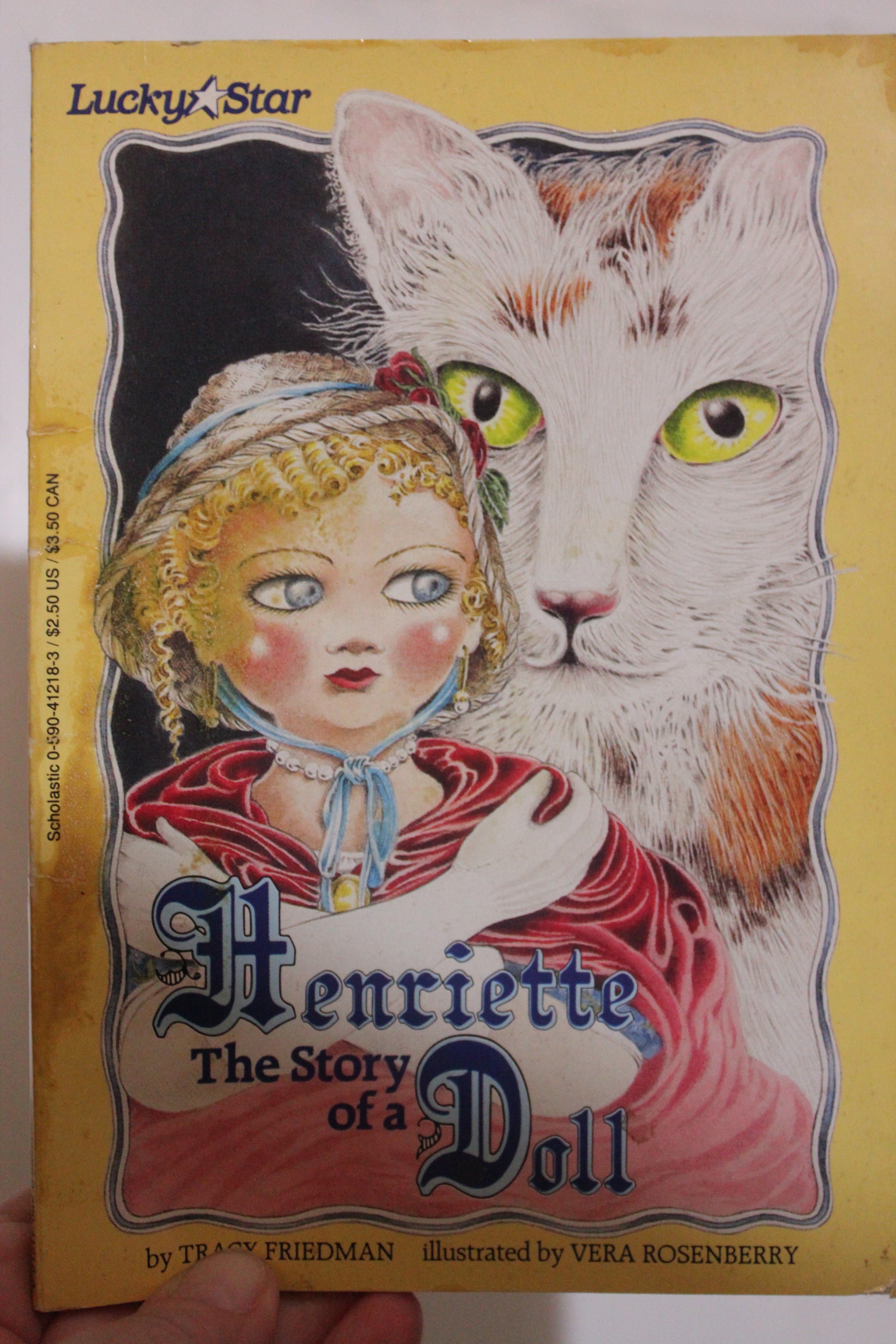
The Doll Book of the Month Club: Henriette, The Story of a Doll

   This month's Doll Book of the Month Clun entry is Henriette, The Story of a Doll, by Tracy Friedman. The illustrations are by Verna Rosenberry.


  Henriette is a beautiful china doll from France. The book opens with Henriette in the warmth and comfort of her elderly owner's arms, in a cozy chair. 


When her owner, who was given Henriette when she was a child, opens a letter, out drops a gold locket. The locket belonged to the daughter of Henriette's owner. Henriette had been passed on to the daughter, but the daughter had moved away as an adult and left Henriette behind. 


The Civil War ensued, and after a time, the daughter, (and her husband), passed away, but not before having a child of her own. Henriette's owner had tried to find her granddaughter, Amanda, and finally the locket had been sent as proof that  Amanda had been located. She is in Atlanta, in an orphanage. Henriette's owner sadly decides that Amanda would be better off being adopted than coming to live with an old lady on a decaying plantation.

  When the owner leaves the room, Henriette knows what she must do. She was meant to be Amanda's doll, and she must get to Amanda before she is adopted and lost forever. And, a doll after my own heart, Henriette decides to take the locket back to Amanda too, as it should be with her. Henriette does something most dolls in books like this don't get to do: She communicates with her owner. She writes a note to her owner, telling her where she has gone, and promising she will try to bring Amanda back. She digs through her trunk of clothes and puts on a red velvet cloak and a straw bonnet, and sneaks out through the kitchen, and into the wide world. Luckily a load of cotton is about to be sent to Atlanta, and Henriette is just in time to hitch a ride.


  This book reminds me a bit of Hitty, or The Miraculous Journey of Edward Tulane , (Click on those titles to read my reviews), in that it tells of a doll's journey somewhere, and her adventures along the way.


 'Henriette' has neither the complexity of Hitty's story, nor the poetry of Edward Tulane's, but then, it's much shorter than either of those books.  'Henriette' is a short, 64 pages, and if you have patient children who can sit for somewhere between half an hour and an hour, (I didn't time my read, and I don't know how fast you read.), you could cover the book in a sitting. It's an entertaining book, although I wasn't quite satisfied altogether with the ending. It didn't really settle everything. It's almost like there should have been a sequel. And there was! The sequel is called, "The Orphan and the Doll". I think both books should have been combined into one satisfying story, but I guess there were a couple of years in between. I think I can still recommend 'Henriette'. 

Wednesday, June 1, 2022

The Doll Book of the Month Club: My Dollies ABC

   This month's Doll Book of the Month Club entry is an oldie. It's "My Dollies ABC".


  This book is pretty old. I can't find a date on it any where, and I can't find the book on line. 


It's obviously an old original though, and not a reprint. It's made of linen, with a paper cover. Ken's stepmother once gave toddler Emma an old linen book she had, and Emma chewed on it and the blue cover made lovely creamy blue spit!

  It's an ABC, or alphabet book, so there's no story, just rhymes, and pictures showing something that starts with the letter. As you may have guessed from the title, dolls figure into things. 


Like this peg doll.


Because of the era of this book, the illustrations are pretty, but some of the words(and depictions) are a bit racist. (Can you really be a 'bit' racist? It's like being a 'little pregnant'. You either are or you aren't.) 

This one is actually complimentary. There's a worse one though. It's not awful, but a bit cringey.

I like these old children's books for the illustrations, and this one is pretty   


  That's it for this month's book. Coming up, an antique store find, a couple of reviews, and who knows what else! And next month's book will be a review too! Stick around!    


Thursday, April 28, 2022

Doll Book of the Month Club: Polar the Titanic Bear

   This month marks the 110th anniversary of the sinking of the Titanic, and you should know by now that I have a Titanic obsession. So this month's Doll Book of the Month Club entry is connected. It's Polar, The Titanic Bear, by Margaretta 'Daisy' Corning Spedden.

My book doesn't have a dust jacket, so the title page will have to
suffice.

  The book is written from the point of view of a stuffed toy polar bear named Polar. (We now know Polar to have been a Steiff bear.) It was written as "My Story",  by Daisy Spedden in 1913, as a Christmas gift from Daisy, to her son Douglas, and never meant to be published. 

Daisy's original, hand painted cover for the book she gave Douglas.

We owe the existence of this book to someone else. The book was discovered in Daisy's trunk, many years after her death, by Leighton H. Coleman III. Leighton's grandmother had been a cousin of Daisy's. Leighton spent his summers with his grandparents, and at age 14, poking around in what has been called variously a 'shed' and a 'barn' discovered Daisy's trunk. When he was a bit older he perused the contents more thoroughly, discovering Daisy's photo albums and diaries, along with her hand written copy of Polar's tale. When he was 21 his grandfather gave him the trunk, seeing his interest in the family history it contained.  Eventually Leighton sent copies of Daisy's accounts of her Titanic experiences, and Polar's book, to a Titanic historical society, which led to him deciding to publish Daisy's Polar book. An illustrator was found, and the book was first published in 1994, the year before the actual long lost Titanic was discovered.

  It follows Polar's story, as he is completed in a workshop, packed up, and shipped to FAO Swartz in America. He's bought by a lady, and presented to her nephew, Douglas, in the Autumn of 1911, as he and his family are about to leave on a trip.

Illustration from the book, by Laurie McGaw.

  Polar goes on many adventures with Douglas, as his family travels to exotic places, and back home to their mansion. 


  Polar has his own furniture, and shares all special events with the family. I was reminded, reading Polar's story, how Emma and Fuzzy took their special dolls, named after them, everywhere we went, including vacations. Those dolls went more places than I did until I was in my twenties! 

  Polar keeps Douglas company while Douglas recovers from measles, a deadly illness back in Polar's day. 


Luckily for Polar, he's washed in disinfectant and kept, and not thrown on the trash heap to be burned, like the Velveteen Rabbit. (I'm not crying! You're crying!) But this is Polar the Titanic bear. Where does that come in?

  Well obviously the wealthy Spedden family booked passage on the Titanic, and you know what happened with that. Mr. and Mrs. Spedden were awoken by the jolt of the crash with the iceberg. They dressed and went on deck to see what had happened. They could see already that the ship was listing, so they hurried back to their rooms to wake their servants. Douglas was awoken by his nanny, 'Muddy Boons', (Douglas originally couldn't pronounce her name, Maggie Burns, and so she became 'Muddy Boons'.), who dressed the groggy boy, telling him they were going on 'a trip to the stars'. Luckily for Polar he was placed in six year old Douglas' arms as the family were heading for the deck and the life boats. Luckily for Mr. Spedden, Douglas' father, there were no more women or children around as the life boat was being lowered, and he was allowed to climb in, along with Douglas and Polar, Daisy, Daisy's maid, and Douglas' nanny.  So, the entire Spedden party survived the sinking. Douglas, in the arms of Muddy Boons, famously slept through the entire ordeal of the freezing night in the boat, with icy waters seeping in, to eventually reach up to the passengers knees. 


When he awoke in the morning, shortly before being rescued, he exclaimed, "Muddy, look at the beautiful North Pole with no Santa Claus on it."

  Daisy was a photography buff, as well as a dedicated diarist, but unfortunately her camera was lost on the Titanic. (Ken and I both said we would have grabbed our cameras, both for the photos on them, and to record the obviously historic events that were happening. Even if it wasn't obvious that the sinking would become so historic because of the circumstances, there was always the fact that it was supposed to be unsinkable. The mere fact that the ship so proclaimed to be unsinkable was going down would have warranted recording in photos.) There does, however, exist one photo of Douglas on the Titanic. Father Francis Browne was given a ticket for the Titanic as a gift. He was an accomplished photographer, and took many pictures during his time on the Titanic, including one of Douglas playing with his top on the deck, as described in Polar's story. 

Father Browne's photo of Douglas aboard the Titanic. Muddy Boons can be seen partially obscured by the gentleman on the far right.

Father Browne's ticket was for passage to Ireland, but he was seated at a dinner table with a wealthy American couple, who so enjoyed his company that they offered to pay for his ticket to New York. Father Browne sent a telegraph to his superior, requesting the additional time off, and received the response, "GET OFF THAT SHIP". I wonder if he thanked the man later!

  The book continues with events after the sinking. It doesn't seem to have been considered quite the historical event to turned out to be. 


Not that Daisy wasn't greatly affected by the experience. She wrote in her diary that after the Titanic tragedy, "...all the values of our life changed, and the daily incidents, which once seemed of such importance to us, dwindled into mere trivialities." Daisy, who had never worked a day in her life, as a wealthy person from birth, had helped care for the Titanic's survivors aboard the rescuing ship, the Carpathia, cutting up blankets to be made into clothes for survivors who had been rescued in night clothes, and had no other clothes with them.  

  Although Douglas survived the Titanic's sinking, there is a tragic ending to Douglas' story, making one of the book's final Polar quotes even more heart wrenching. At the end of the book "Polar" explains that he realizes he will spend less and less time with Douglas as the years go on, but he will be happy to know that Douglas is living a happy life. And Douglas did live a happy life after the Christmas of 1913, but only for 19 more months. During the Spedden's yearly summer vacation at their home in Maine, Douglas chased a wayward ball into the road, where he was hit by a car. Two days later he passed away from his injuries, at the age of nine, becoming the first automobile casualty in the state. 


  The Spedden's continued to travel and take photos, but Daisy never wrote in her diary again, after Douglas' accident. As for Polar, the book says no one knows what happened to him, as he has never been found. I wondered if perhaps he was buried with Douglas. That was the question I put to a Facebook page dedicated to the story of Polar, and the Spedden family, run by Leighton Coleman. (You can find it HERE.) I received a message back, (Not necessarily by Coleman, as he may not do the actual day to day responding from the page.), saying that Polar had indeed been interred with Douglas. I don't know what changed the story as to Polar's whereabouts. My follow up query about the previous statement that Polar's fate was unknown was met with only, "Now you know!" 

  That's the book for this month. I realize Polar is probably considered a 'toy', and not a 'doll', but I think Douglas' method of play with Polar gave him 'doll' status. When she was small Emma informed me that all her stuffed animals were "dolls". So there you go.

  There's a doll show in a couple of days. That should be interesting. I'll let you know how it goes. 

Thursday, March 31, 2022

The Doll Book of the Month Club: Moveable Mabeline

   This month's Doll Book of the Month Club entry is "Movable Mabeline", by Karen Ackerman. 


  The book, originally published in 1990, concerns two little girls, sisters named Isobel and Mimi, who see a beautiful doll in a shop window. The doll, 'Moveable Mabeline',  is sitting in her own little white 'straw' chair, and the girls are instantly in love with her. 

They are so taken by her that they dare to enter the grown up shop.

The shop clerk even let's them hold Mabeline.

The story seems to be set in the 1920's, or maybe 1930's. It may be during the depression. In any case, the girls know the wonderful doll, with a pink satin dress and movable joints, is certainly too expensive for them to hope for. 

"Moveable Mabeline! Yours and mine! Yours and mine!"

But they can't stop thinking about her. For weeks they drive their mother crazy, talking about Movable Mabeline. The girls have dolls at home, mostly worn hand me downs, (They look pretty good in the illustration!), but Mabeline is still on their minds.


  Finally, they accompany their mother on a shopping trip. They pass the store where Movable Mabeline is sitting in her chair in the window. They are excited to show her to their mother, but Mother just pats their heads.

  After that day the girls pass the shop window again, and Movable Madeline is gone.  The girls believe that their mother bought Movable Madeline, and is keeping her as a surprise for them. But day after day passes, and Movable Mabeline never appears. 


  The next year 'moveable' dolls are everywhere. The girls both get one for Christmas, but they still long for Mabeline.


  Will they ever see Movable Maybelline again? Where is she?

  It's a nice book, with a slightly less than predictable ending. It's not the most obvious ending, but maybe the next most obvious. That's okay, because this is a kids' book, and that's the way they usually work. 

  Author Karen Ackerman is another native Ohioan, from Cincinnati. Among her many awards, she won the Caldecott Medal for her 1989 book, "Song and Dance Man".

  The pretty, soft pictures are by Linda Allen, a protégé' of   Tasha Tudor, who has written and illustrated her own books, including The Giant Who Had No Heart.                           .

  The age recommendation for this short picture book is 7 to 9 years old. 

  That's the book for this month. I'll see you again soon!

Tuesday, February 1, 2022

The Doll Book of the Month Club: Doll Hospital, Charlotte's Choice

  Can you believe we've reached the end of the first month of the new year already?! Time really flies. Ivy went back to college yesterday. There' a surge of Covid in Indiana in general, and her college specifically, so I'm worried. At least she recently got her booster, when we did, while she was home.

  So anyway, I'm on my own again while Ken's at work. Know what that means Raging Moon and Barb? It means I'll soon be digging out those dolls for you. I'll also be listing some more dolls and doll things on the blog's sales page. What doesn't sell on the page in a month or so will go on Ebay for a slightly higher price, since on there I have to cover the fees. (Can you believe they now take a share of the money paid for shipping too! That's for shipping! I don't even get any of that! It's because a lot of people were trying to avoid the Ebay fees on their 'final value', so they priced the item very low and charged a crazy rate for shipping. Now we all have to pay part of our shipping money to Ebay! I always put a regular price on the item, so that means I don't actually get what I asked for anything now, because part of my profit goes to pay shipping. I hate Ebay.) 

 This month's Doll Book of the Month Club entry is really a series of books. The series, by Joan Holub,  is called "Doll Hospital".  Although we'll concentrate on The book "Charlotte's Choice", we'll also talk about the series in general.

  The series 'Doll Hospital' books are about two sisters, 8 year old Lila and 10 year old Rose, who are sent to live with their grandmother  when their doctor parents go to Africa for a year to work. They call their grandmother  'Far Nana', because she lives far from them, and they have rarely seen her. The idea of them living with her is so they can get to know her better. Far Nana is a bit of an old hippy. She wears lots of bead necklaces, which click together when she moves. She also repairs dolls, thus the 'doll hospital' of the series title. 

  But the interesting thing about Far Nana's doll repairs is that when Far Nana repairs the dolls, they 'talk' to her, (Not out loud.), and they tell her their histories. Far Nana tells the stories to Rose and Lila as she works. That's how we learn the stories, as the reader is obviously listening in. 

  There are six books in the series. The first was "Tatiana Comes to America", the story the girls' arrival at Far Nana's, and of a doll who escapes Russia in 1907. The second book was "Goldie's Fortune", and the doll in the story is from the Depression era. Third in the series was "Glory's Freedom", and the doll was the doll of a slave traveling the Underground Railroad. The fourth book in the series was "Saving Marissa", about a doll from the 1950's. The fifth book was "Danielle's Dollhouse Wish", the story of an 1890's dollhouse family from Paris. (I'd like to get hold of that one.)

  The book we're looking at more closely is, as I said, "Charlotte's Choice", the sixth and final book in the series. 


In this book, Lila and Rose have just gotten off school for winter vacation. They want to go to the Winter Carnival, but Far Nana has other plans, which infuriates the girls. Far Nana tells the girls they are going to an historic Shaker village, where Far Nana is going to visit an old friend and repair a doll for her.


  Lila and Rose decide to give Far Nana the cold shoulder, to let her know how mad they are that they don't get to go to the Winter Carnival. Far Nana's friend works at the Shaker village, which is now a tourist site, and Far Nana and the girls are going to be staying in the 'dwelling house' at the village. 


The doll Far Nana is going to repair was found in an attic in the village. The doll has paper mache' limbs, (except for  a missing leg), a cloth body, and a wooden head. 


But dolls and toys weren't allowed by the Shakers until well after the era of this doll. How did she get in the attic? What's she doing in the Shaker village? 


Maybe Far Nana will find out as she repairs the doll. (In the process of repairing the doll we learn how Far Nana makes a new paper mache' leg by making a mold of the remaining leg and casting a new leg.) And do Lila and Rose get over being mad at Far Nana? Do they end up enjoying their visit to the Shaker village? 

  Of course, you probably have figured out that, of course Far Nana tells the doll's story, of course the girls get over being mad at Far Nana, and of course they enjoy their visit. That's how these books go. But  is it an enjoyable journey getting to the end of the story? Well, yes. These books are fun. It's never  explained whether or not Far Nana can really 'hear' the dolls' thoughts, or if she's making it all up. I like to think she has a little magic and can really hear the dolls. I suppose I would also have enjoyed them as a kid because there's always a little history in each book too. I always loved history. Ivy liked these books when she was little, and we read two or three of them. 

  The book is a quick  read of less than 130 pages, about the length of all the books in the series. The age recommendation is ages 8-10. It could be read to younger children if they are interested.

  Author Joan Holub has written a lot of books for kids. And I mean A LOT. More than 180, in fact. She acquired a Fine Arts degree and spent a few years as an art director with a graphic design firm. But she always wanted to write kids' books. Eventually Joan moved to New York and got a job designing books for Scholastic Books. She also edited books for them. In 1992 the first book she had illustrated was published. She became an illustrator, until the publication of her first authored book, in 1996.  Today Joan Holub is 66, and apparently has cats named after Scout and Boo from "To Kill a Mockingbird". (One of my favourite books, so I have to love that! By the way, I highly recommend "To Kill a Mockingbird" to everyone, and the movie is great too!) 

  Oddly enough, Joan Holub didn't illustrate the Doll Hospital books. They're illustrated by Ann Losa. I guess Joan is too busy these days writing those 180 plus books to illustrate them too. But the illustrations by Ann Losa are nice. 

  That's it for this month's book. See you again soon.